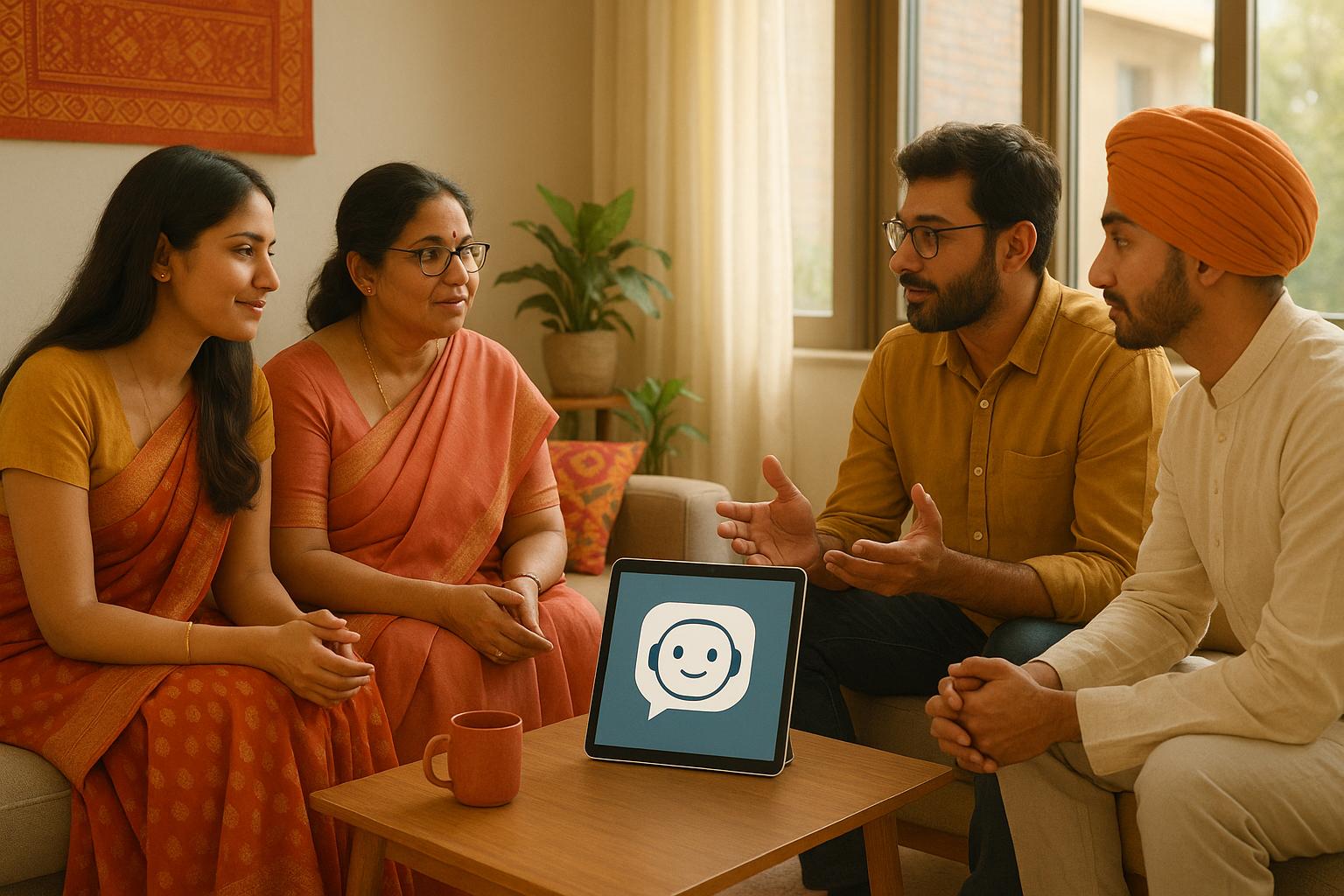

Why AI Needs Cultural Sensitivity in Emotional Support
Why emotionally supportive AI must be culturally aware in India — addressing language, local cues, datasets, and design steps for safer, relevant support.
Mental Health
Dec 17, 2025
AI-powered emotional support systems are gaining traction worldwide, but they often fail to address the nuanced emotional and linguistic needs of diverse populations. In India, where mental health services are limited and stigma around seeking help remains high, AI has the potential to fill a critical gap. However, many systems fall short due to a lack of contextual understanding and region-specific communication styles.
Key takeaways from this article:
Emotional struggles are deeply influenced by language and societal norms. For example, in India, over 150 million people need mental health support, yet 83% of them lack access to care.
AI systems often miss the mark by offering generic responses that fail to resonate with India's diverse cultural and linguistic landscape.
Tools like Vibe aim to address this by supporting Hinglish, Hindi, and English, while tailoring responses to users' emotional and conversational styles.
Solutions include training AI with localized datasets, tagging data with emotional and social cues, and involving local experts to ensure relevance.
India’s mental health landscape demands AI systems that are not only empathetic but also contextually aware, bridging the gap where human support is unavailable.

India's Mental Health Crisis and AI Adoption Statistics
Problems Caused by Culturally Unaware AI
Generic Responses and Their Limitations
AI tools often fall short when they fail to account for India's rich cultural diversity. For example, the struggles of a young professional in Mumbai facing intense career pressures are vastly different from the family expectations that might weigh on someone in Srinagar. Yet, many AI systems offer generic advice, treating all emotional challenges as if they share the same context.
A striking statistic reveals that nearly 57% of Indian youth use AI tools like chatbots for emotional support. However, many feel that the responses they receive don't align with their lived realities. Imagine an AI suggesting a young person "set boundaries" with their parents, without understanding the deeply intertwined family relationships common in India. Or advising someone to "take time alone", ignoring societal and familial obligations. These one-size-fits-all solutions often fail to resonate, leaving users feeling misunderstood.
This disconnect highlights a larger issue: the inability of many AI systems to truly capture the nuances of India's communication styles and cultural expectations.
Challenges for Indian Users
India's linguistic and conversational diversity poses a unique challenge for AI systems. In smaller towns, where 43% of youth are more likely to confide in chatbots than their urban counterparts, conversations often flow between Hindi, English, and regional dialects. This fluid use of languages, often peppered with Hinglish phrases or local slang, can confuse AI systems that aren't designed to adapt to such linguistic shifts. When the AI fails to recognise these nuances, it misses critical emotional cues.
Take Rafiq, a 19-year-old NEET student from Srinagar, as an example. He shared, "Here, if anyone visits a psychologist, people call them crazy. So I talk to AI instead." For someone like Rafiq, turning to AI is a way to navigate the stigma around mental health. But if the AI doesn't understand the cultural weight of his situation - like the stigma he faces or the societal expectations in his community - it cannot provide the meaningful support he needs. This is particularly concerning in a country where over 83% of people with mental health needs do not receive care. AI, which could serve as a bridge to fill this gap, often falters due to its lack of cultural awareness.
How AI Can Reinforce Stereotypes
The problem doesn't stop at ineffective support. Culturally unaware AI can also perpetuate harmful stereotypes. Many AI systems, trained predominantly on Western data, simplify India's complex social fabric. For instance, assumptions about arranged marriages, family dynamics, or career paths can alienate users by reinforcing outdated or inaccurate views. Instead of challenging these biases, the AI may unintentionally validate them.
The impact of this disconnect can be profound. A survey found that 42% of Indian youth felt less inclined to open up to people in their lives after relying on AI for emotional support. This growing isolation, coupled with AI systems that echo rather than challenge harmful patterns, creates a vicious cycle. Users lose trust in AI, and its potential to provide meaningful emotional support diminishes significantly. In a country with such pressing mental health needs, this failure is not just a missed opportunity - it’s a serious setback.
AI for All: How India is carving its own path in the global AI race
How Vibe Addresses Cultural Awareness

Vibe breaks down real-world barriers by offering emotionally aware and culturally sensitive support. Let’s dive into how Vibe’s language adaptability and personalised approach tackle these challenges.
Support for Hinglish, Hindi, and English
Unlike conventional systems, Vibe seamlessly navigates linguistic shifts and local slang to truly understand emotional undertones. Whether it’s a casual “yaar, I’m so stressed about exams” or a fluid mix of Hindi and English, Vibe captures the essence of what you’re feeling.
This is especially important in India, where language is deeply tied to identity. Shreyak Singh, Co-Founder at Knockverse, highlights this perfectly:
"We didn't want to build another dry, robotic chatbot. We wanted to create something emotionally available - a voice that actually texts back when you're spiraling at 2:43 AM."
By meeting users on their terms - speaking how they naturally speak - Vibe avoids the rigidity of English-only communication, making interactions more relatable and human.
Personalised Conversations
Beyond its language flexibility, Vibe tailors its responses to match your unique communication style. Whether you need a calm, empathetic tone or a more straightforward approach to vent frustration, Vibe adjusts itself to meet your emotional needs.
What sets it apart is its ability to remember what you’ve shared, creating a connection that feels authentic rather than transactional. This personalised approach not only mirrors how you communicate but also builds trust, addressing the lack of emotional sensitivity in traditional systems. As Kruthivarsh Koduru, Co-Founder at Knockverse, explains:
"Everyone is building AI to sound smart. We thought - what if it just made you feel better?"
This focus on emotional support over technical brilliance redefines what users can expect from AI - making it a comforting companion instead of just another tool.
Methods for Building Culturally Aware AI
To address the issues of generic responses and cultural insensitivity, developers are turning to specialised training methods and carefully curated data. These approaches aim to improve AI's understanding of cultural nuances and enable it to respond more appropriately in diverse contexts.
Role-Playing with Context
One approach involves training AI using culturally relevant scenarios to better understand emotional dynamics. However, research led by Chen Cecilia Liu and her team in August 2025 highlights a limitation: “simple cultural role-play is insufficient for cultural sensitivity.” Their study, which evaluated four strategies for adapting large language models to respond with cultural sensitivity, found that superficial role-playing often falls short in providing the depth needed for meaningful emotional support.
Tagging Context in Training Data
Another method focuses on tagging training data with detailed cultural annotations. This involves labelling not only words but also cultural signals, emotional undertones, and contextual nuances. For example, AI can be trained to understand that "family pressure" may carry vastly different meanings in collectivist societies compared to individualist ones. Similarly, certain expressions in Indian contexts might convey specific emotional weight. This tagging helps AI identify subtle patterns, such as why users in some cultures may express distress indirectly rather than stating it openly.
Using Localised Datasets
Training AI with localised datasets is another powerful strategy. Take CultureCare, for example - the first dataset designed for culturally sensitive emotional support. It includes 1,729 distress messages, 1,523 cultural signals, and 1,041 support strategies. Models trained on CultureCare consistently outperform generic systems. When compared to anonymous online peer responses, these models showed marked improvement, as confirmed by evaluations from in-culture human annotators and clinical psychologists.
Steps to Design AI for Emotional Support
Creating AI that is sensitive to cultural nuances requires thoughtful planning, from tagging data to incorporating human oversight. David Livermore, a noted author and social scientist, highlights an important challenge:
"AI defaults to the dominant cultural values embedded in its training data, often resulting in generic responses aligned with Western norms".
This underscores the need for developers to consciously address these biases. Below is a structured framework to weave cultural sensitivity into AI design, ensuring more inclusive and meaningful interactions.
Step 1: Tag Context in Data
Go beyond basic translation and focus on tagging cultural cues. This means labelling emotional expressions, social norms, and language variations. For instance, consider how "family pressure" might be expressed differently: in collectivist cultures, it could be described indirectly, while in individualist cultures, it might be stated more openly. These detailed tags help the AI respond to individuals without falling back on stereotypes.
Step 2: Use Tailored Prompting
Once the data is tagged, guide the AI with prompts that include specific cultural contexts. For example, instruct the AI to adopt a "warm, collaborative tone for Brazil, a formal tone for Germany, and a style that emphasises innovation for India". These tailored prompts ensure responses resonate with the cultural expectations of the user.
Step 3: Test with Local Experts
Bring in local experts to evaluate the AI’s responses for cultural relevance. Their expertise helps identify overlooked slang, misinterpreted cues, or advice that might be inappropriate in a specific context. This step ensures that the AI aligns with local norms and sensitivities.
Step 4: Add Human Oversight
Incorporate human oversight to catch errors that algorithms might miss. Vishal Bhalla warns that AI without human checks could come across as clinical or tone-deaf. Regular human reviews help avoid stigma and ensure the advice remains appropriate. This ongoing input not only preserves authenticity but also allows for continuous refinement based on real-world feedback.
Conclusion: The Future of Culturally Aware AI
Cultural sensitivity is shaping up to be a cornerstone for the future of AI in emotional support. While 54% of global consumers have turned to AI for emotional or mental well-being, a striking 60% feel that these systems fall short in delivering the empathy needed for genuine human connection. This highlights a critical gap: as technology expands its reach, it must also deepen its understanding of diverse cultural landscapes.
In India, with its incredible linguistic diversity, culturally aware AI becomes essential for offering nuanced, region-specific emotional support. Take, for example, platforms like Vibe, which cater to multiple languages to ensure natural and culturally attuned communication. Such initiatives not only make emotional support more accessible but also address the pressing shortage of mental health professionals in the country. By providing round-the-clock assistance that aligns with regional communication styles, these AI systems are stepping into a much-needed role.
However, linguistic diversity is just one piece of the puzzle. Building trust is equally critical. Globally, 50% of consumers rank privacy and data security as their top concerns when engaging with AI platforms. To bridge this trust gap, AI systems must combine transparency, cultural relevance, and strong data protection. Efforts like the creation of specialised datasets such as CultureCare - which spans four cultures and includes 1,729 distress messages and 1,523 cultural signals - show promising progress in this direction. Additionally, large language models adapted for cultural nuances have demonstrated greater sensitivity compared to anonymous online peer responses.
To tackle these challenges, a set of clear design principles emerges as a roadmap: tagging cultural context, crafting tailored prompts, involving local experts for testing, and ensuring human oversight. These strategies, discussed earlier, provide a solid foundation for building AI systems that honour diverse perspectives while delivering meaningful support. Collaboration among developers, cultural specialists, and local communities will be vital to achieving this goal.
With younger generations increasingly relying on AI - 35% of Gen Z and 30% of Millennials already use it for emotional support - the urgency to develop inclusive and respectful systems is greater than ever. AI that can seamlessly adapt to any cultural setting not only improves user experience but also nurtures more authentic and meaningful human-AI interactions.
FAQs
How can AI be trained to provide culturally sensitive emotional support?
Training AI to provide emotional support that respects cultural differences requires careful planning and execution. A good starting point is using diverse and inclusive datasets. These datasets should capture the linguistic, social, and emotional subtleties unique to various cultures. Adding cultural context to these datasets helps the AI recognise differences in communication styles, emotional expressions, and values.
Beyond that, fine-tuning AI models for specific cultural scenarios ensures the responses align with the emotional needs of different communities. Collaborating with professionals in fields like psychology, sociology, and linguistics can add depth to the AI's understanding, enabling it to pick up on cultural cues and foster more empathetic exchanges. By focusing on inclusivity and cultural sensitivity, AI can create interactions that feel more meaningful and tailored to individuals from diverse backgrounds.
How does language diversity impact AI's ability to provide emotional support in India?
Language diversity plays a key role in enabling AI to provide meaningful emotional support in India, a country rich with a vast array of languages, dialects, and regional expressions. By recognising and adapting to widely spoken languages like Hindi, Tamil, Bengali, or even blended languages like Hinglish, AI can forge a deeper, more personal connection with users.
This sensitivity to linguistic and cultural differences helps build trust and creates a sense of belonging. Whether someone expresses their emotions in their mother tongue or seamlessly switches between languages, an AI that respects and reflects this diversity can offer emotional support that feels personal and relatable, perfectly aligned with India's vibrant and varied cultural fabric.
Why is it important for AI in emotional support to consider cultural sensitivity?
For AI systems that provide emotional support, understanding and respecting cultural differences isn't just a bonus - it’s essential. When AI takes into account cultural nuances, language preferences, and social norms, it creates interactions that feel more genuine and tailored to the individual.
This level of understanding helps avoid missteps like miscommunication or displaying unintentional biases, which can leave users feeling disconnected or misunderstood. On the flip side, culturally aware AI builds trust and promotes inclusivity. It ensures users from all walks of life feel acknowledged, valued, and supported - making the interaction not just functional, but meaningful.