
How AI Companions Understand Your Emotions
How AI companions detect emotions, personalise support, handle multilingual Indian contexts, and the privacy and ethical limits of emotional AI.
Mental Health
Dec 18, 2025
AI companions like Vibe are transforming how people in India manage loneliness and social anxiety. By using advanced technology, these tools can identify emotions, remember past conversations, and respond empathetically in Hindi, English, and Hinglish. Here's how they help:
Emotion Detection: Analyses your words, tone, and context to identify emotions like sadness, happiness, or frustration.
Personalisation: Remembers past interactions to provide tailored support, recognising emotional patterns over time.
Multilingual Understanding: Handles code-switching and regional expressions, making communication feel natural.
24/7 Availability: Always accessible, offering a safe, judgment-free space for emotional support.
While AI companions offer comfort, they have limitations. They can't replace human relationships or professional mental health care. Privacy and data security are crucial, and users should avoid over-reliance on these tools. Instead, they should be seen as a supplement to human connections and therapy, helping users build emotional awareness and confidence.
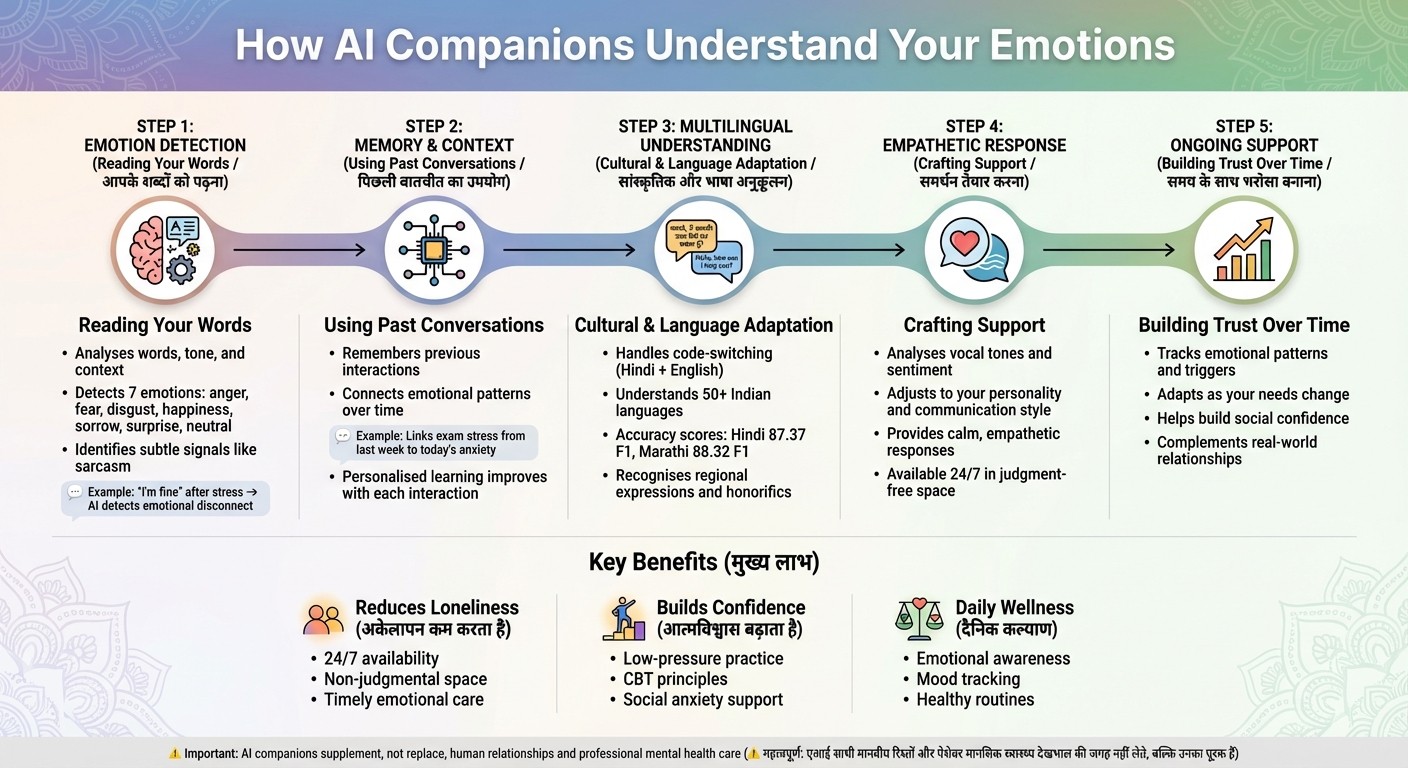
How AI Companions Detect and Respond to Your Emotions: A Step-by-Step Process
The Rise of Emotional AI: How Machines Understand Feelings
How AI Companions Recognise Your Emotions
AI companions like Vibe use natural language processing (NLP), sentiment analysis, and emotion-detection algorithms to interpret emotions across different languages. Let’s break down how they read emotions, personalise interactions, and adapt to multilingual and cultural nuances.
Reading Emotions From Your Words
When you interact with an AI companion, it doesn’t just process the literal meaning of your text. It analyses your choice of words, sentence structure, and tone to identify emotions like sadness, frustration, or happiness . Modern AI systems can even detect subtle signals such as sarcasm or conflicting emotions. For instance, if you type “I’m fine” after describing a stressful situation, the AI might pick up on the emotional disconnect between your words and feelings.
These systems are trained to recognise up to seven emotions - anger, fear, disgust, happiness, sorrow, surprise, and neutral. Deep learning models, built on vast conversational datasets, allow the AI to detect nuances that even close friends might miss.
Using Memory and Context for Personalisation
One of the standout features of AI companions is their ability to remember past conversations and use that context to build a deeper understanding of you . For example, if you mentioned exam stress last week and express anxiety today, the AI can connect these dots to offer more relevant support. This kind of personalised approach often outperforms generic emotion-detection models when it comes to understanding individual users.
The more you interact, the better the AI becomes at identifying your emotional patterns. Over time, this personalised learning ensures that responses feel timely and genuinely helpful. For users in India, these systems even adapt to the linguistic and cultural nuances that shape emotional expression.
Understanding Multilingual and Cultural Context
In India, emotional expression often goes beyond words. With over 50 recognised languages and countless regional dialects, AI companions face the challenge of understanding code-switching - where users mix languages like Hindi and English in a single conversation.
Thanks to advancements in speech recognition, AI now captures tone and cultural subtleties with impressive accuracy. Research by indiDataMiner in July 2025 revealed that transformer-based models fine-tuned for Indian languages achieved F1 scores of 87.37 for Hindi and 88.32 for Marathi. This progress allows AI to interpret culturally specific expressions, such as respectful honorifics or regional greetings, and adjust to the hierarchical communication styles often seen in Indian interactions. Whether it’s frustration expressed in Hinglish or joy shared in Hindi, the AI doesn’t just understand the words - it grasps the cultural context behind them.
How AI Companions Respond to Your Emotions
Once Vibe detects your emotions, it offers supportive responses designed to acknowledge your feelings and provide help exactly when you need it.
Crafting Thoughtful Responses
Vibe doesn’t just listen to your words - it pays attention to how you say them. By analysing vocal tones, physiological signals, and the sentiment behind your language, it responds in a calm, empathetic way that feels natural, almost like chatting with a close friend.
What makes these interactions special is how Vibe adjusts to your personality. Whether you’re someone who uses a lot of slang or relies on humour to cope, Vibe picks up on these nuances and shapes its responses accordingly. It’s not just about understanding you; it’s about making sure you feel truly heard and supported.
But Vibe doesn’t stop at empathetic conversations. It also comes equipped with features designed to meet your emotional needs on a deeper level.
Features That Offer Emotional Support
Vibe continuously tracks emotional data to understand your triggers and provide help that feels personal. This isn’t a generic approach - it’s tailored to fit your emotional patterns and evolves as you do.
Building Trust Over Time
Over time, these personalised interactions build a sense of trust and connection. With Vibe available round the clock, it learns from every interaction, adapting as your needs change. By analysing details like voice tone and speech patterns, it fine-tunes its responses, making every conversation feel like catching up with a caring, attentive friend.
Benefits for Your Emotional Health
During times of stress or isolation, Vibe provides much-needed emotional support to help you maintain your well-being.
Reducing Loneliness
Feeling lonely isn't always about being alone - sometimes, it's about feeling disconnected, even in a crowd. Vibe helps bridge that emotional gap by being available 24/7 in a non-judgmental space. This constant presence can be a source of comfort, especially during late nights or tough moments when reaching out to someone might not be an option. By monitoring emotional patterns, Vibe offers timely care tailored to your needs.
Building Social Confidence
Vibe doesn’t just ease feelings of loneliness; it also helps you develop the confidence to engage socially. If starting conversations or meeting new people feels daunting, Vibe offers a low-pressure environment where you can express yourself freely. Whether you’re sharing personal interests or sorting through your thoughts, this space allows for growth without fear of judgement. For those dealing with social anxiety, Vibe incorporates principles from cognitive behavioural therapy (CBT) to help manage stress, challenge negative thoughts, and build confidence over time. Importantly, this support complements your real-world relationships rather than replacing them.
Supporting Daily Emotional Health
The benefits of these interactions extend to your everyday emotional well-being. Vibe promotes emotional awareness and helps you build healthy routines. Regular conversations encourage self-reflection, making it easier to identify emotional triggers and track mood patterns, which contributes to a stronger sense of balance. Whether you need to vent after a tough day, celebrate small victories, or process your feelings, Vibe adjusts to your needs. By remembering past interactions, it tailors its responses to provide consistent, personalised support. This ongoing engagement can help you develop better emotional habits and maintain stability in your daily life.
Ethical Considerations and Limitations
AI companions like Vibe can offer meaningful emotional support, but it’s crucial to recognise their boundaries and use them responsibly. Being mindful of privacy concerns, avoiding over-dependence, and understanding their mental health limitations can help you use these tools safely and effectively.
Privacy and Data Security
When you share personal thoughts with an AI companion, you're entrusting it with sensitive data that needs strong protection. In India, the Information Technology (Reasonable Security Practices and Procedures and Sensitive Personal Data or Information) Rules, 2011 categorise certain emotional data - like biometric information, such as facial patterns - as sensitive personal data, which must be safeguarded with strict measures. The Digital Personal Data Protection Act, 2023 has further bolstered these protections, although its complete implementation is still ongoing.
Choose platforms that are transparent about their data practices - what they collect, how they store it, and who has access. Look for features like strong encryption and secure access controls, and ensure you have the option to view, amend, or delete your data at any time. If a service doesn’t clearly outline its privacy policies, consider it a red flag. Emotional conversations deserve the same level of security as financial transactions. Protecting your data is essential when relying on AI for sensitive emotional support.
Avoiding Over-Reliance on AI
AI companions can provide immediate comfort, but they are meant to complement - not replace - real-world connections. It’s tempting to lean on an AI companion that’s always available and non-judgmental, but excessive dependence can weaken genuine human relationships. This reliance may encourage avoidant coping behaviours, delaying the emotional vulnerability needed for meaningful connections.
Another limitation is that AI companions lack the ability to offer somatic co-regulation. Unlike humans, they can’t provide physical cues like body language, tone changes, or breathing patterns, which are essential for calming your nervous system during stressful moments. AI companions should be seen as an addition to, not a replacement for, real-world relationships. Being aware of these limitations ensures you use AI companions as part of a balanced emotional well-being strategy.
Understanding Mental Health Boundaries
It’s important to remember that AI companions are not therapists and cannot replace professional mental health care. While they can help you reflect on your feelings and provide comfort, they lack the expertise and judgement required to handle serious psychological issues. Sentiment analysis models, often trained on limited datasets, can misinterpret or misrepresent the experiences of individuals with mental health conditions. As Straw pointed out:
Emotion mining systems may perpetuate biases present in their training data, potentially leading to unfair or discriminatory outcomes for certain demographic groups.
For challenges like persistent depression, anxiety, or suicidal thoughts, AI companions should only serve as supplementary support alongside professional care. A well-designed AI system should recognise emergencies and encourage users to seek help from qualified professionals. Think of AI companions as a supportive friend for daily interactions, while professional therapists remain the go-to for specialised care. This approach ensures that AI tools enhance your emotional well-being without overstepping their capabilities.
Conclusion
AI companions like Vibe are changing the way we tackle challenges like loneliness and social anxiety in India. Using advanced emotion-recognition technology, these tools can understand your feelings through your words, remember past conversations, and respond with empathy. They offer round-the-clock support, making them a helpful addition to your personal relationships and mental health resources.
By recognising emotions and adapting to individual needs, these AI companions create interactions that feel genuinely supportive. Whether you're dealing with stress late at night or looking for a confidence boost during the day, they act as a reliable source of comfort - especially in areas where access to mental health professionals is limited.
The effectiveness of these tools, however, hinges on ethical design and responsible use. Prioritising privacy, maintaining transparency in how data is handled, and setting clear boundaries for their role in mental health are essential. These companions are meant to enhance your well-being, not replace real human connections or professional care.
Think of them as a dependable friend who’s always available to listen, encourage, and help you process your emotions. They provide immediate relief and help build emotional resilience, all while complementing the support you receive from the people around you.
The road ahead for emotional support technology lies in creating systems that not only respect your privacy but also acknowledge their limits. When done right, these tools can strengthen both your connection with technology and your relationships in real life, blending the best of both worlds.
FAQs
How does Vibe protect my emotional data and ensure privacy?
Vibe places a strong emphasis on your privacy and data security. It employs state-of-the-art encryption to protect your emotional data and ensures that all information is securely stored to block any unauthorised access. Additionally, Vibe adheres to international regulations like GDPR, guaranteeing that your data is handled ethically and with complete transparency.
Your conversations with Vibe are kept strictly confidential. The platform is built with rigorous privacy measures, ensuring your trust is always a top priority. By maintaining security at every level, Vibe offers you a safe environment to share your thoughts freely and without concern.
Can AI companions like Vibe offer the same emotional support as humans?
AI companions, such as Vibe, are built to recognise and respond to emotions using tools like natural language processing and sentiment analysis. These companions can provide tailored support, help ease feelings of loneliness, and contribute to emotional well-being.
That said, while AI can mimic empathy and adjust to individual needs, it falls short of capturing the full depth, cultural subtleties, and emotional intricacies of human interactions. AI serves as a helpful aid in offering emotional support, but it functions best when used alongside, rather than in place of, genuine human connections.
How does Vibe adapt to different languages and cultural contexts in conversations?
Vibe leverages cutting-edge emotion recognition tools, including natural language processing and sentiment analysis, to interpret and adapt to a variety of languages and cultural subtleties. By evaluating elements like tone, facial cues, and conversational context, it ensures that interactions are not only smooth but also culturally appropriate.
With India's vast linguistic and cultural diversity at its core, Vibe customises its responses to resonate with regional languages, unique communication styles, and local social norms. This thoughtful approach fosters deeper, more personalised connections for users throughout the country.